Sunday, September 30, 2012

Point Bennett Project - The First Cut is the Deepest!!


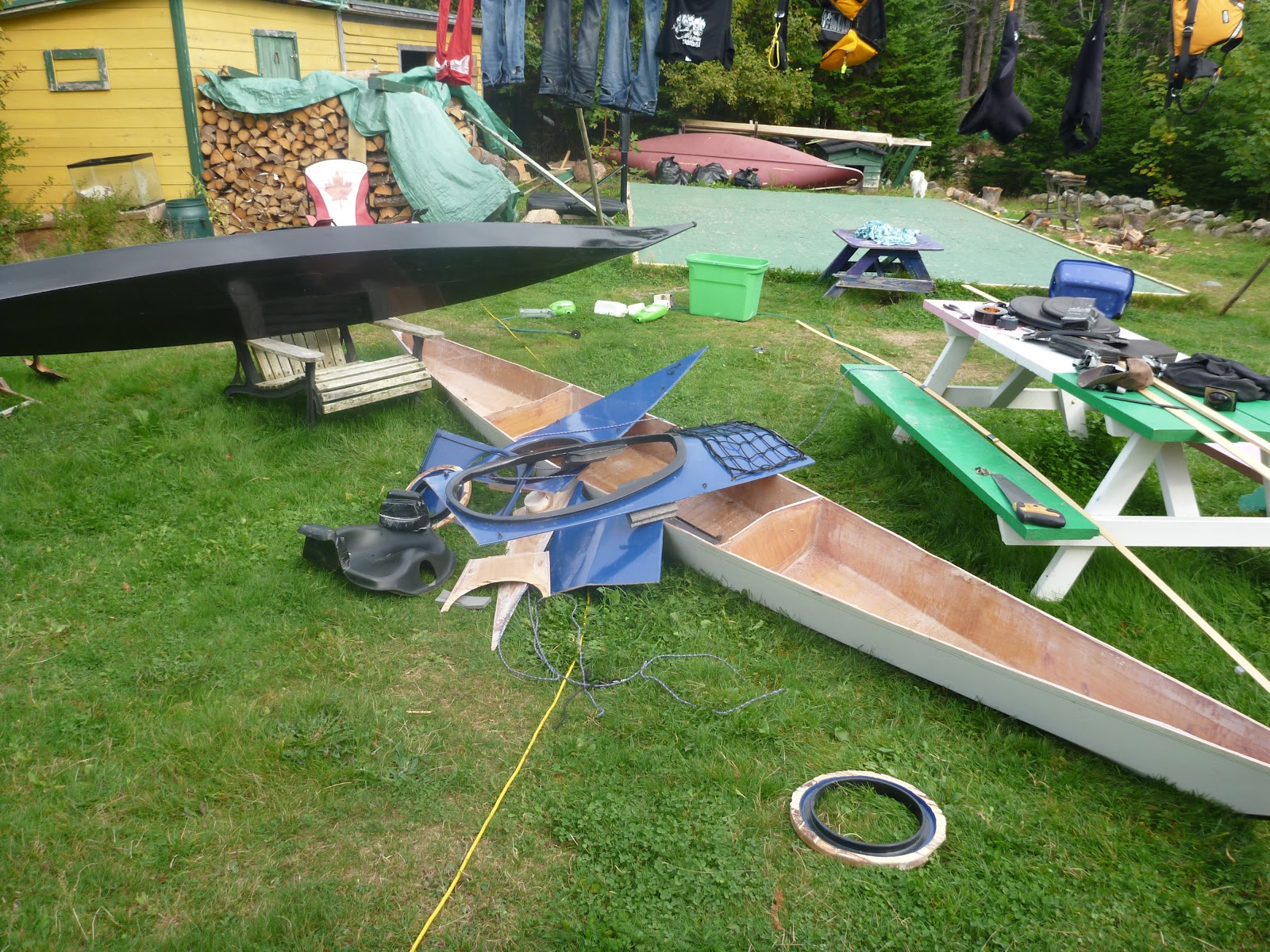
In my previous posting, I outlined my intent to re-do the deck on my Point Bennett S&G boat. Well, today, I  decided I was going to rip the deck off. I'd been playing around with some profile shapes over the past few weeks but I figured now it was time to actually do something about it. So I spent an hour this afternoon (Sunday) chopping up a boat that I so lovingly built only a year and a half ago!! How things change!!!

A note of caution. Some with weak constitutions (or the inability to comprehend such mutilation of their boats) may find some of the following pictures a bit disturbing!!  I, by the way, have no fear doing major modifications to my boats. I figure that if I put the deck on there in the first place, I can damn well rip it off and replace it with another. 'Nuff said. Let's get the gory details of the surgery!!


Prepped to go under the knife.

For now I am simply removing the deck so I chose to cut right along the sheer line.

The first cut!!

No turning back now!!

Finishing off the first side!!

I need to separate the deck from the internal bulkheads and because I was not re-using the deck, I simply made cuts in the appropriate places to expose the bulkheads for easy cutting with the saw.


The El Camino Kayak!!

The plywood rings holding the hatch coamings were epoxied to the sides of the hull and required some extra cutting to remove them


Fwd hatch coaming holding on!!

A shot of the carnage!!!

With the deck completely removed I was transported back in time to February 25 2011 when I was at this very stage when initially building the boat.

Deck finally off and the hull ready for "height reduction"!!

The next step is to mark and cut the new sheer line. I already have the new sheer marked but I need to do some close scrutiny to make sure it's what I want.  After that, it's back to the attic for the boat and the rebuilding of the new deck, coaming and installation of a skeg.

Thanks for dropping by and my apologies for the disturbing content,

Sean

Friday, September 21, 2012

Fall/Winter Project - The Point Bennett Goes Under the Knife


I vowed not to build another boat for a while, yet there's still that urge to create  In spring of 2011 I built my Point Bennett, a plywood stitch and glue boat designed by Duane Strosaker. While I really enjoy paddling the boat, there are few things that I'd like to change - all, with the exception of one, have to do with the deck. So, you guessed it, the deck will be coming off!!

Why, you may ask?  Well, here's why:

The Point Bennett was designed to carry camping gear and such, so, while it is far from high volume, it has more than I need. (I have no desire to camp from my kayak). Once I cut the deck off, I will proceed to drop it. This will not only lower the volume, it will also drop the height of the cockpit coaming in the back. I find the current height a bit hard for layback rolls and such.

When I replace the deck, I will be going with strips rather than plywood. Strips are much easier to come by here than marine plywood. Plus the strips will allow me to build a rounded deck that may help with foot room when I drop the height!!!  Plywood does not lent itself to bending so you are more restricted in what shapes you can make.

I was NEVER happy with the cockpit size and coaming!!  When I originally cut the opening, it made it too big and of course once it was done, I was pretty much committed. I also built the coaming out of stacked plywood rings which, while pretty simply, is big and bulky. After seeing the job I did on my Black Pearl, I will be going the coaming made of laid up fibreglass. I will also make it a keyhole style. And SMALLER!!

In addition to reducing the size of the coaming, I am going to recess it as well. This will lower the height even more. I'm not sure how I'll be doing this yet but I have some ideas!

Like the cockpit, I was also NEVER happy with my padeyes (the deck fittings that hold the lines). They leaked from the get-go and when I finally got them tight, I didn't like the system I used.  When I replace the deck, I will be going with the Maroske, a used on my Black Pearl. They are strong, watertight and very pleasing to the eye.

Hopefully, I will be able to re-use my hatch coamings. I think I can safely cut them out and re install them in the new deck.

I never put a skeg in this boat when I built it but, later, I had occasion to wish I did. Seeing that I'll have the deck off, now is the time to install one. I have a Kajaksport skeg on order from Newfound Woodworks. Although the PB can be paddled without a skeg, sometimes it's nice to have that tracking assistance!!

And what do I expect to get out of this?

I currently have my Black Pearl and Point Bennett side by side and upside down in the backyard. Their hulls below the water time are incredibly similar in shape - albeit the BP has more rocker!!  I am expecting the LV Point Bennett to be fast, nimble and a great roller. It will have a little more volume than the BP, so it'll carry a bit more gear. The skeg will be an added bonus in certain wind conditions.  The new cockpit  will be cleaner and less open.  The padeyes will be lot strong with no fear of breakage. The deck will have more curvature. I may/may not see a reduction in weight - this remains to be seen.

I am guessing that many, upon seeing the "new" Point Bennett will assume that I've built a new boat.

When I first dreamed up this project, I figured it was simply a matter of cutting off the deck and replacing it but when you look at it, the deck is the most time consuming part of the entire build.  I'm rearing to go!!

Thanks for dropping by,

Sean

Sunday, August 26, 2012

The Glacier Walk-Around


In my last posting, I introduced our new boat, the Glacier by EasternIsland Kayaks. I'd like to take this chance to show some of the details of the craft. 

I was a bit apprehensive about buying a tandem as some of them are quite ugly and do not even resemble kayaks. After the designer/builder Craig Greenham sent me recent pictures of one he'd just completed, I was quite amazed that, while still a fairly big boat, the Glacier still has the nice lines and look of a fine kayak. Those pictures that Craig sent, sold us on the idea of buying the Glacier.

Many tandems have very high decks and I was concerned that it would be an issue for Cheryl and I as we both use Greenland paddles. (I find that I hit my fingers off the deck of higher boats when I paddle). I also explained to Craig that we did not intend to use the boat for heavy touring, so greater storage capacity was not a necessity. As a result I asked that Craig drop the deck by 1" -  which he said he could do with no problem.  The result is what can be called a Glacier LV. The coaming height at the front of each cockpit comes in at 13" - which is pretty low for any boat. Lowering the deck height also also makes the boat look a bit more sleek, in my opinion.

This is not a heavy tandem either. Cheryl and I carried it with relative ease from the car to the water and back in St. Philip's today. Getting it back on the rack is not too hard either. Still. this is a 20' boat so it's going to be handful to move around not matter what weight. I'm guessing that it's about 80 lbs. Craig offered to do the boat in carbon/Kevlar for further weight reduction but I did not see the need.

Now, on to the tour  . . . 

Profile shot showing dropped deck.

Looking aft.

Looking fwd.

After taking in the overall shape of the design, the next thing that hits you in the craftsmanship that Craig puts into his boats. The layup is superb and his attention to detail really stands out.

Let's start with the cockpits . . .

The seats mounts are integral to the cockpit coaming. The seat, itself, is bolted to the mount with two screws on each side. These screws allow slight pivoting of the seat. The seats themselves are very comfortable.  Craig used Kajaksport backbands which provide good support and are easily adjustable using large velcro straps. The coaming is very smooth with no sharp edges. The coamings are a pretty standard size, too. Not big and sloppy liked you'd expect in a tandem, Our Seals 1.4 sprayskirts fit perfectly which saved us a chunk of money by not having to buy new ones. The aft bulkheads are angled and the joins are very clean.

Craig left the foam off the thighbraces as he figured we'd like to do the customizing ourselves - which is quite true.  The footbraces in the forward cockpit are by Kajaksport.

The two images below give a good indication of the clean look and feel of the cockpits. Very nicely done.

Fwd cockpit.

Fwd cockpit.

I was giving the rudder a good looking over when Craig told me that he makes all the parts himself. I was quite impressed. This is a well made and solid setup. He even uses 1/8" braided SS cable - which is a substantial size and it's not hard to tell that it's a step above what other commercial boats use. I'll admit that after we ordered the boat, I began to wonder what kind of rudder system Craig would install. I've seen some chintzy systems but no worries about that here. Craig really came through with this boat!!!


Made right here!!!!

Of course, I was also wondering about the style of rudder pedals as well. I was afraid that I'd end up with the   sliding type. Again, Craig came through with flying colours when he installed the Kajaksport "gas pedal" system. In this case, the pedals remain stationary and you simply pivot them with your toes to activate the rudder.  We had a somewhat similar system on our Prijon Seayak but this setup is much more comfortable.


Gas pedal for the rudder!! Take note of the clean FG layup on the hull and bulkhead!

Rubber hatches are not an option on this boat but I'm more than pleased with the ones it has. Each hatch lip is built up just like a small cockpit coaming.  Craig has a sprayskirt company make up the neoprene covers. The hard cover for the hatches is laid up fibreglass with a gel coat finish. The images below show the three steps of hatch closing.

Looks just like a tiny cockpit coaming!

Neoprene cover is nice and tight.

The gloss of the gel coat matches the rest of the deck nicely!!

In all the images above you will notice the clean look of the deck and the fittings. All hatches, coamings and deck fittings are recessed and all have excellent drainage too so that no water stays on the deck. These are signs of a designer who pays attention to detail.

Today (Sunday) Cheryl and I took the boat out for a 2.5 hr paddle. We both noted that the seating was quite comfortable and I must admit that it's nice having the leg room to stretch out. (My Black Pearl is VERY tight and there's no leeway when it comes to "foot space").   We were getting much better at staying in sync as well once I adjusted my stroke rate. I think we will have lots of fun with this boat.

Well, that's a quick look at some of the key features of the boat. I will try to do another posting on paddling impressions after we spend some more time in the saddle, so to speak.

Cheers and thanks for stopping by,

Sean

Saturday, August 25, 2012

Introducing . . . The Glacier


I am just going to post a few images of our latest addition to the fleet. The detailed review will have to wait until we finally get a chance to get the boat on the water!!

Briefly, the Glacier is a glass double built and designed by Craig Greenham of  Eastern Island Kayaks. Craig can design and lay up a boat that will rival and, in many cases, better some of the world's renowned kayak companies.  On July 24th, I gave Craig the green light to build us a new boat. It was ready for pickup on Aug 24th. That's not a bad turn-over for a hand built boat!!!

Cheryl and I drove out to Twillingate to pick up the new boat. We made a chance for some "away-from the-kids" time and spent the night in Gander alone. We drove to Twillingate the next morning to meet Craig. He had the boat prominently displayed on his lawn so that we'd know which house was his. In hindsight, the boat on the lawn in slings would've made an excellent picture - insert face palm here!!!

Our initial impressions of the boat were "wow" and "holy crap, what a beautiful job"!!!

After speaking with Craig for about an hour, settling the score, and strapping it the top of the car, we headed off for Twillingate lighthouse for a look-around.


At Twillingate Lighthouse.

Showing the nice lines!!

Twillingate as the backdrop!!!

When we finally got home and took the boat off the car, we had a chance to look at the craftsmanship. No doubt, I will be doing a full review in the near future. For now, we are just champing at the bit and waiting to get this thing on the water!!!

Cheryl checking out the primary and secondary stability!!

Stay tuned for further updates!!

Thanks for dropping by!!

Sean

Monday, June 18, 2012

The C-Monster's New Paddle

A fellow paddler, I'll just call him The C-Monster, asked if I would make him a Greenland paddle. I really like making paddles but lately have not had any reason to do so. This was my excuse to start a new project.

I'm not going to outline the build as it is pretty much standard . . . 


Still working out of the dining room

Schedule 40 clamps on the loom. Western Red Cedar sandwiched in between Spruce.

All glued up and ready for shaping.

Weight before any shaping - 85oz!

Using a power planer for the initial shaping.


Forming the taper.

Weight after cutting the tapers on the blade - 58 oz.

Add caption

Shaping the blades.

ABS pipe cut to fit.
Once I have the rough shape finished with the power planer, I move onto a small block plane, rasps and sandpaper. Some may frown upon the use of the power planer, but it works wonders - very fast wonders - when you need to remove lots of wood, quickly!!  If you are careful, it does a great job!!  Just don't let your attention lapse or you can easily ruin your work.

I knew that the C-Monster, would be spending time near the rocks, so I offered to put on a plastic tip protector. I have one on my paddle and it does an amazing job of saving the soft wooden tips It also allows you to use a sharper tip on the paddle which makes it a lot quieter in the water.


Showing the inset into the paddle tip.

Plastic being epoxied onto the blade.

Tip after sanding.

Paddle after shaping , sanding and wetting out.


I failed to get a final photo of the paddle before I handed it over to the new owner. I went with the all-black tips - like I have on my paddle.  The paddle is 88", with a 20" loom. The blades are 3 3/8 at the tip. It weighs 31 oz. Like all my paddles, I finished it with Tung Oil.

I hope that the C-Monster gets a lot of good paddling out of this one!!!

Friday, June 8, 2012

From the Archives - The Pre-Black Pearl?


I was sorting through some old photos a few days back when I found these images. I figured they'd be the good basis for a retrospective blog entry. Very timely given the recent launch of my new boat, the Black Pearl.. 

Let the memories (or lack thereof) begin . . . 

Back in the mid 1980's, I happened upon a National Geographic article (sorry I looked but can't find the reference) that had a photo of a traditional Greenland  kayak being constructed. It was simply a picture of the frame lying on the barren rocks.  I would've been in my late teens by this time but I still had the kayak bug from several years prior. See this blog entry for a better explanation

I decided that I was going to build a "traditional" Greenland kayak based on that picture. Having no access to Internet or even books on the subject, I set out on the rather bizarre project.  Actual memories of the construct are very vague at best. It was built outside in the garden. I first drove two posts in the ground at a distance equal to the length of the keel.. Then I drove in a third in the middle slightly lower than the other two. The keel was laid across the two ends posts and then bent down and fastened to the center one to give the boat its rocker. How much, I cannot say!!

I had no plans or drawings so I cannot honestly say how I came up with the hull shape. At the time I did not realize that the ribs were steam bent, so I went with a method, that I now know, is somewhat akin to the one used in the Arctic regions - including Labrador. My ribs  were not one  full piece of wood bent and running sheer to sheer. In my case  it took three pieces of wood to make the "ribs" -  one piece that ran from sheer to chine. Then another that ran from chine to chine across the keel. And a third piece that ran from chine to sheer on the other side. Hard to explain but sorry, not one picture of this build!!  All fastening was done by wooden pegs and wood glue - not even waterproof glue, at that!!

And that is about all I can remember about framing this boat.  The boat was framed up for a while and actually languished out in the backyard for quite some time - perhaps two years??  After this lengthy hiatus I deiced to finally finish the thing - after having spent so much time on it prior!!

The original plan was to cover it in canvas but for some reason that idea was nixed (probably because the  fastening job was beginning to fail due to exposure to rain and snow) and I decided to sheath it up with Masonite - don't ask!!!  I cut the panels, tacked them to the wooden frame and using fiberglass mesh tape  (the kind used in drywall!!!) and fiberglass body filler, I sealed up the seams!! A coat of black pain and we were good to go!!

I feel almost embarrassed in describing this build but it is what it is  - and that is an attempt at building a boat purely based on a single photograph. There were no Internet forums with their almost instantaneous advice, no plethora of online images of how a traditional kayak was built or even what one looked like. I didn't check but I highly doubt the public library had any books on the subject. So that leaves you entirely up to your own "devices"

And what of the boat, itself??  Once I had it painted, my then girlfriend and now wife of 21 years, took it to the pond. That voyage proved to be both its maiden and final all in one!!  Somehow or other, a camera made it to the event and the four images below are all that were even taken of this craft. 

Having proved the craft did, indeed, float and could be paddled, we put it back on the car, drove back to the cabin and promptly deposited it behind the woodshed - where it stayed, rotting,  for a number of years until I chopped it up with a saw. 

True story!!


Young,  foolish and quite dashing, I might add!!

Well, it moves at least!!

The only profile image of this boat. Doesn't look too bad!


Cheryl never left the shore - and I don't blame her!!


Sunday, May 27, 2012

Black Pearl Project - Makin' a Foam Masik


I'm still working on customizing the cockpit and the next on the list is the masik. In a traditional wooden framed kayak, the masik is the curved deck beam that supports the front of the cockpit. It also acts as a brace against which to press the knees for better body to boat contact. My boat has no need for the masik as a deck beam but it does require one as a brace.

I made mine out of closed cell foam, a.k.a., interlocking foam floor tiles.


Foam floor tile.

I simply cut three strips about 1.25" wide. I laminated the strips together with Goop.

Strips ready for laminating

I glued up the strips and placed them inside the hull to get the right curvature. After they set up for a few minutes, I pulled out the masik and put on a raft of Schedule 40 clamps to squeeze the strips together tightly as the Goop dried.

Looks like some giant plastic caterpillar!!

After the Goop dried, I used 60 grit sandpaper to round out the edges.

Sanding.

After test fitting a few times, I glued the masik in place using Goop.

Masik in place. Clamp is holding pump holder clips in place while the epoxy dries.

The foam masik gives a very firm support for my thighs - just above the knee. I was noticing that pushing my legs up against the glass inside the deck was not good for my drysuit - the weave is not fully filled with epoxy which leaves a rough surface. Also, the foam is much more comfortable to push against than the wooden deck.  I've yet to try it on the water, but it certainly feels comfy on the land!!