Sunday, September 25, 2011

Where it all began . . .


In the "About Me" section to the right of this post, you'll see that I mention making a skin on frame (SOF) kayak at the age of 13. For years (perhaps 30) this little boat has languished in the crawlspace under my uncle's log house. I knew it was there but never really bothered to look at it - until this weekend.

With the completion of my new SOF, the Disko Bay, I experienced a new desire to see the boat where it all began, i.e., my interest in kayaking and kayak construction. I decided to dig out the old boat and see how I made out with the build.

Before moving onto the pictures, there are a number of things you must take into consideration:

a) I was only thirteen,
b) I had never laid eyes on a real kayak other than in pictures,
c) I built this without any adult help whatsoever. My Dad worked at Horwood Lumber and provided me with the materials but everything else was done solo, 
d) I did not have a workshop. I built in the kitchen at first and later in a makeshift shelter outside and
e) I did not have a plan. I simply drew it up and went from there.

For 30 years in a damp, unheated, dirt-floored crawlspace, the boat has held up remarkably well. There is no rot in the wood and only one section of canvas has shown deterioration.

The boat measures 13' feet long by 21" wide with a foredeck height of 11". Initially the foredeck was flat with a very small opening for the legs. I found this too hard to enter so I raised the foredeck by adding a curved piece onto the existing frame. I then stitched in a new piece of canvas to accommodate the structural changes. This added piece of canvas is the only one showing significant damage.


When I raised the foredeck, I added two pieces of plywood to either side to give the cockpit a more oval shape than the initial fully open rectangle.  I added a backrest but I'm not sure why I made it pointy!?!?!? Not the best boat for doing layback rolls, what??


Cockpit looking fwd.

Showing the raised foredeck.
I'm not sure how I came to know about how to build a SOF but my construction techniques are not a whole lot different than those used on the Disko Bay.

You will notice that I screwed up on the stringer placements. Instead of placing the middle stringers at the chine, I put them in the middle. This resulted in the ribs/frames poking out the canvas. I did not notice this until I had the thing skinned and as the paint dried, it pulled the fabric taut and my mistake became painfully obvious. I always thought that is made the hull look like a starving cow!!

Looking fwd.

Port bow. Can't remember if the rocker was intentional or not.

Certainly not fancy but a good first try for a 13 yr old!!
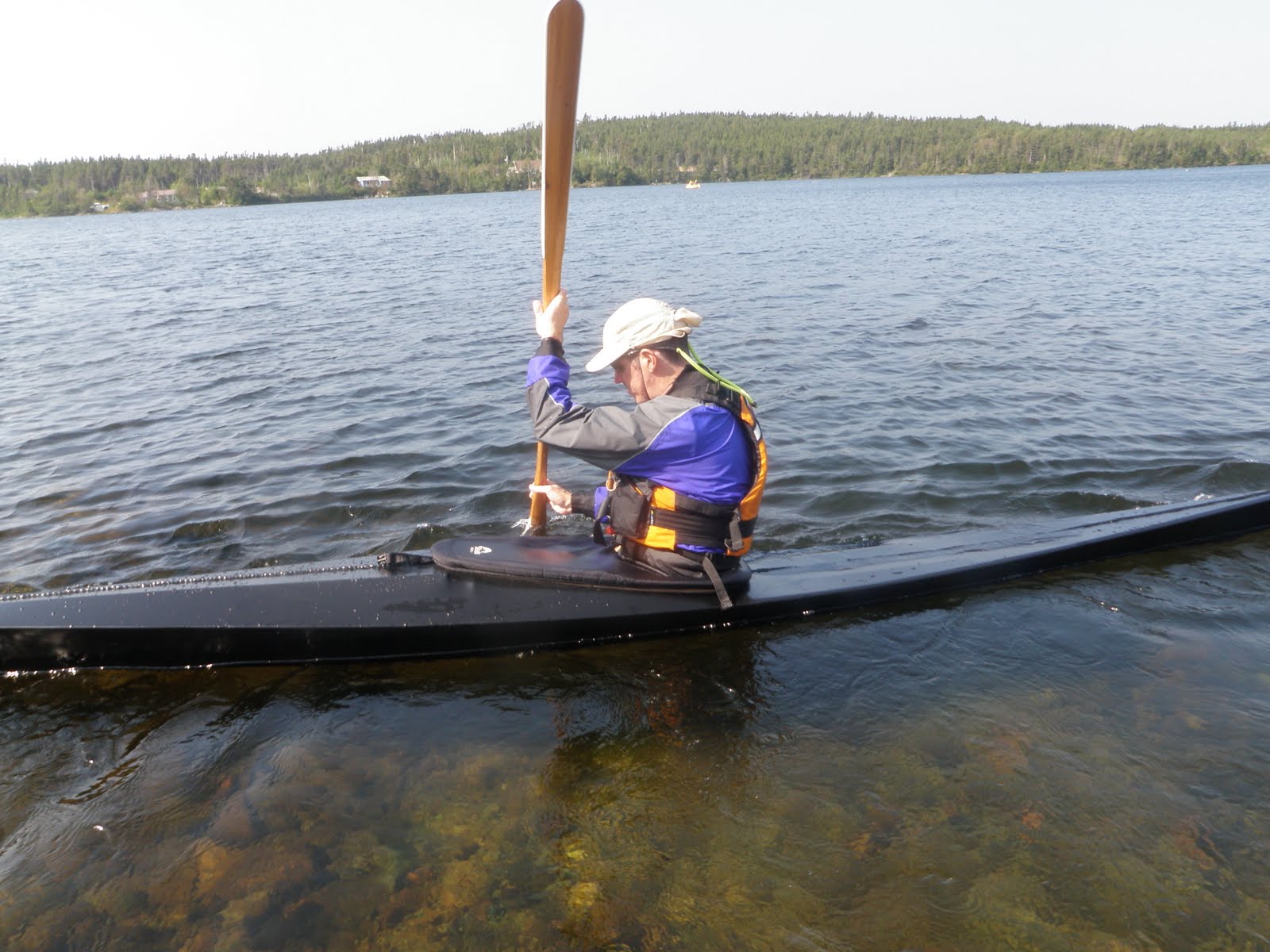
If you are to paddle, then, obviously, you need a paddle. If you can build a boat, then you can build a paddle, I figured. My Dad gave me a piece of handrail and I fastened two plywood blades - and voila, an unfeathered kayak paddle. I re-found the paddle a couple of years ago in the woods and saved it from the elements by putting it in the shed. This weekend is the first time in 30 years that they've been reunited.

Boat and paddle - reunited and it feels so good.
I'm thinking that I'll put this boat in my basement now. It's dry and free of bugs or any other creatures who'd do it harm. It'll never hit the water again but it will hold it's place with my other boats.

As I was revisiting the past with this old boat, my Disko Bay was close by getting a new coat of paint. While these two boats are world's apart in finesse and craftsmanship, they are basically the same concept. It's just that one was built by a 13 year old boy with no knowledge of kayak design and/or construction. The other was built by a 45 year old man with a wealth of information found on the Internet and in books, with all the necessary tools and a workspace and with firsthand knowledge on how to actually paddle a kayak. All things considered, that 13 year old boy did alright, don't you think?

SOF - the latest iteration.

Hmm, this one doesn't look like a starved cow.

Thanks for dropping by and reliving a little history with me.

Sean

Tuesday, September 6, 2011

A house gives birth and a maiden voyage - yet again!!

Back in April of this year, I launched a new boat and I made a blog entry titled - A house gives and a maiden voyage. Well, now its just over 5 months later and I am making a second blog entry with the same name.

With the exceptions of deck rigging and stem/stern keel strips, my Disko Bay is finished.

Below are some pictures showing the boat leaving the house and of its maiden voyage.

Look familiar??

No snow on the ground this time!!

Disko Bay meeting the rest of the "family"

Hanging out by the pool, i.e, fish pond.

The blunt end!

The pointy end!!

Very nice profile!!

Very nice lines!!

Lean and mean at a mere  28lbs!!

Obligatory standing-on-end shot!

Baffin and Disko ready to hit the water!

I decided to take the boat to the pond for its maiden voyage. I made this decision for a couple of reasons - a) there was a bit of wind on the bay and I was not sure how the boat would handle, b) I was not sure how hard it would be launching from the beach and c) I do not have my flotation bags made yet.

Cheryl and I packed up the car, racked the two boats and hit the pond.

The boat certainly handled a lot better than the last time it was on the pond!!  Freeboard was a bit low, as to be expected, but at least it did not sink (hahahaha)

I'm not sure if the low freeboard is affecting edged turning but it seemed like the boat wanted to turn to the edged side as opposed to away from it. Still experimenting to check this out.

This boat is no pig. It can be brought up to pretty good speed.  Initial stability is a bit low but easily gotten used to!

As was anticipated, this boat rolls very nicely. The total height at the back (including the coaming) is just 6.75" so lay back rolling is a piece of cake. My first roll went so easy that I came flying up like a rocket. My current boat rolls easy but the force required for this one is far less - I guess I used too much power!!  Sculling braces are a breeze and balance bracing will come very easily!


Sittin' pretty!

Just scullin' about!!


Image form a video capture of sculling.
We spent about 1.5 hours puttering around the pond.

I'll admit that I was bit disappointed in how the boat felt and handled. It just seemed pretty much like any other of my boats - with the exception of the rolling and other stationary manoeuvres. I figured (hoped) it was just that it was new to me. We packed everything back up and headed home. On the way home we drove through St. Philips, an area where we often take short paddles. There was a good breeze blowing but the water at the shore was calm. A great chance to take the boat out on the salt water. I'm sure glad I did.

I launched without incident. The low masik on the boat makes my regular entry impossible - one leg followed by the other. This boat requires a lot more balance. Inside the harbour it was pretty calm - a good place to get a feel for the boat. As I moved out around the headland, the wind/waves increased a fair bit. The weather station at the local yacht club was recording winds of 14 knots at the time. Nothing out of the ordinary but at least it gave me a better feel of the new boat. After paddling for a few minutes, I came to a decision that this boat will never touch the pond again!! On the salt water it was a different beast. The movement of the water brought the boat to life. It seemed to turn quicker. It flexed with the waves. I was happy to see that it did not plow through the waves as much as I was expecting. It rode them quite nicely. There was enough wind and wave to create some surf-like conditions as well. I caught a few waves and the boat tracked nicely - it was not pushed off to the side, nor did the bow dig in nor the stern get pushed under. I was impressed given its low volume and my weight (just under 200lbs).


Putting in a St. P. There was a crowd of about 30 people on the beach!
In the end, I'm glad we made the detour to St. Philip's. It showed me the capabilities of this boat. Besides, it is a West Greenland replica, so shouldn't it be more at home on the salt water?  I think I'm going to enjoy seeing what it can do!!

Thanks for dropping by.

Tuesday, August 30, 2011

Who would have thought polyester could look so look good . . .

Admit it, when you hear of polyester your mind flashes to images of 1970's leisure suits. You know, the kind that Herb Tarlek wore on the sit-com WKRP in Cincinnatti. How can something look good when made of 100 poly? Simple, if you're using 8oz cloth to cover your skin on frame kayak. And even easier when it has nice lines like the Disko Bay. Read on and all will be revealed!! 

As per Dave Gentry's advice I went with 8oz polyester from George Dyson of Dyson, Baidarka & Company in Bellingam, Washington. Within hours of contacting George via email, he had my fabric on the way via post. Using foresight, I decided to order enough fabric to do two boats (Betcha' can't build just one). Somehow George managed to fold and fit all that cloth into one small box and I paid the same cost of shipping as it would for enough fabric to do a single boat. Hats off to George for some of the best service I've received with online ordering. It was too bad that my order was shipped just prior to the national postal strike as my package bounced all over North America trying to get delivered. But I digress!!

I'm not sure about other fabrics but this poly seems really tough. It's a pain to cut with scissors and/or razor blade knife as it tends to unravel. Using a hot knife (no, not THAT kind of hot knife) works great if you have one. I've been cutting it with scissors/razor blades and cauterizing the frayed edges with a small butane torch.

After draping the poly over the frame, I used (you guessed it) Schedule 40 clamps to hold the fabric in place while I did the rough cuts.

Schedule 40s at work on the bow portion of the boat.
After trimming the fabric, I began stitching it up using a simple running stitch. I used a hemostat to hold the already-stitched fabric while I moved on along the seam.  Initally I thought of using dental floss to stitch the seams but was having trouble finding unwaxed (Waxed would cause adhesion problems with the paint used to seal the fabric). A number of years ago I was really into stunt kite flying and I knew I had some Dacron line laying about somewhere. I managed to dig it out and it worked perfectly for the stitching.

It took a few hours, over two evenings, to drape, cut and do the running stitch on both the fore and aft decks. It was not as tedious as I thought it was going to be. I simply flipped on some music, had a beer at the "ready" and got into the "sewin' zone"!!
Stitching up the aft deck

Aft deck running stitch complete.

Stern shot showing the nice lines. 

Aft deck - yet again. Seam is straighter than as shown in this image.
Preliminary testing of fit around the cockpit area. Getting a tight fit will not be a problem.
Move on to  fore deck and repeat . Working above the deck stringers just ahead of the cockpit.

Fore and aft deck running stitching completed. The true shape of the hull finally emerges. I'm a happy camper.

With the seam held with the running stitch, it was time to follow up with another stitch designed to create a tighter closure to the seam. This one was a little trickier and more time consuming.  The idea is to roll the fabric down tight and hold with an overhand (?) stitch. The result, when pulled tight looks like a braid.

Cheryl came up to be with me as the kids were downstairs watching TV. It was a Saturday night and we had a bottle of wine open. I was having trouble doing the roll and stitching so we devised a routine. Cheryl would roll the fabric and hold it while I would follow up with the stitching. It worked like a charm. We'd do a bit, stop and have a sip of wine. Do a bit more. Give the fingers a break. Have a sip of wine. Repeat. Within 2 hrs we had the aft deck completed.

So, Cheryl and I spent the early part of the evening paddling on the bay and later that night we worked on my new kayak while enjoying a few glasses of wine and a few laughs to boot!!


Great teamwork!!

Working our way to the stern.

Cheryl putting her sewing skills to work on the stern.

 
The aft deck completed. A good night's work. And still some wine in the glass - even better!!
On Sunday evening I found that I could, indeed, do the rolled stitching myself so I proceeded to work alone.  In a matter of hours I had the fore deck completed. Sorry no pictures but it came out pretty much exactly like the stern - you get the picture?

Stay tuned. Up next is painting and affixing of the cockpit coaming.

Sean

Sunday, August 21, 2011

Things are coaming along . . .


The coaming was next on the list. I took the template I had from my Point Bennett and reduced it in both length and width. This one is pretty snug to my hips.

I toyed with the idea of making a steam bent laminated coaming but decided to go with a Yost-style plywood setup. It consists of a 1/2" baseplate and a 3/4" + 1/2" spacer and lip combination.(See details below)


Checking out the template.
Using the template, I marked and cut the 3/4" spacer from Russian Birch plywood. I then used the spacer to mark off the lip on the 1/2" plywood. I increased the width of the lip to 1 1/2".

Gluing up the 3/4" + 1/2" spacer/lip combo. Baseplate  against the  wall on the right.
1/2" is too thick for a coaming lip so I decided to router out the lip and bring it down to 1/4" thickness. Using a DIY router table I made about 20 years ago, I reduced down the lip. Now the spacer is 1" thick with a 1/4" lip on top


The underside of the coaming lip. The 1/2" lip has been trimmed down to 1/4" which then increased the spacer to 1".

Baseplate and coaming laid in place.

Test fit. Looks good so far!

Looking aft.

Looking aft.

Before attaching the baseplate, I need to make two stanchions that will support the coaming at the sides. This will greatly increase the stiffness of the coaming and provide added strength at points where extra strain is put on the coaming during entry and exit of the boat.

Monday, August 8, 2011

A different kind of plastic boat . . .

With not a whole lot more work to do on the frame (sand and do a bit more lashing) I decided to do the plastic wrap test. In other words, wrap the frame up with plastic and tape to see how it works in the water!! Cheryl picked me up 7 meters of "medium" weight plastic and, using Gorilla Tape, we set to "skinning" the new boat.  Nothing fancy but it worked!!

We extracted the boat from the attic via the stairs and front window - just like with my Point Bennett back in April. Tied it to the car and headed for Healey's Pond for a quick test.


Wrapped and ready to leave the attic.

Racked.

It floats!!
The masik is a little low so I can't get in like I do with my other boats. I even manged to fit my feet in eventhough I was wearing my booties. I was afraid they'd be too clunky to fit.

First thing we all noticed was the VERY low freeboard - about 1.5" at the sheer by my hips. Still, I was able to take the boat for a paddle and managed to keep water from shipping in. The additional height of the cockpit coaming will help with this. While paddling, I was unable to edge at all but the boat turned nicely.

Squeezing in.
Cheryl shot a short video of me on the first paddle. Here's the link - Disko Bay plastic wrap test

Just sittin' Dig the demon eyes!!
 After paddling about for a bit, I decided to do some edging anyways. After a few dips of the gunwales under the water, the boat proceeded to fill up quickly. Due to the fact that the paddler's weight is in the back and thus boat is inclined to sit lower in the back, all the water rushes backwards and the boat quickly sinks arse-first with the bow in the air!! I ejected but had to the push the boat back to shore while I swam along with it. I was out a few hundred feet at the time - D'oh!!

Dumping the water.

And again.

The last drops!

I was "bouncing" the frame here. There's little bit of flex but nothing much. 

As she floats "unloaded"
I'm a bit unsure about the low freeboard. I'm going to post on the Kayak Building Forum for advice. I can quite easily add 1" to the overall height of the sheer but if I don't have to then I won't.

By the way, for anybody wondering, the frame (sans cockpit coaming) is weighing in at 19 lbs!!!

Sean