Friday, November 18, 2011

A back is a terrible thing to waste . . .

I've been going through any number of attempts at creating a comfortable backrest for my Point Bennett. It started off as a solid foam pillar. This worked for a while until I found that it was creating pressure points on my back and the coaming was digging into my back whenever I tried a layback roll.  As a result I found the boat a pain (literally) to roll and my roll actually suffered because of it. I did very little rolling in this boat this summer and I never even attempted a butterfly as I knew I could not get back on the deck enough to be successful.

After suffering through the "pillar" phase, I just yanked the thing altogether and went "backless" - oh la la!!  This forced me to have a bit better posture in the boat but I soon found myself leaning all the way back to the coaming lip. It also exacerbated the problem with layback rolls as there was nothing between my back and the hard wooden lip!!  Ouch!!

This all lead me to concoct some pretty drastic remedies to lower my rear coaming to help facilitate laybacks. The most "involved" was cutting off the rear deck, dropping the sheer line and replacing the deck!! Ughhh! But I was ready to do this if it meant easier rolls!!

Thankfully I decided to try a new approach for my backrest - a full foam affair that slanted back nicely to accommodate laybacks. I whipped up a prototype (sorry no pictures) and tried it at the Tuesday night pool session. Voila!! An hour of rolling and no pain plus I was getting my back right onto the back deck!! I managed to even get my butterfly back - on both sides.  The stage was set for the "real deal".

Flash forward to Thursday night.

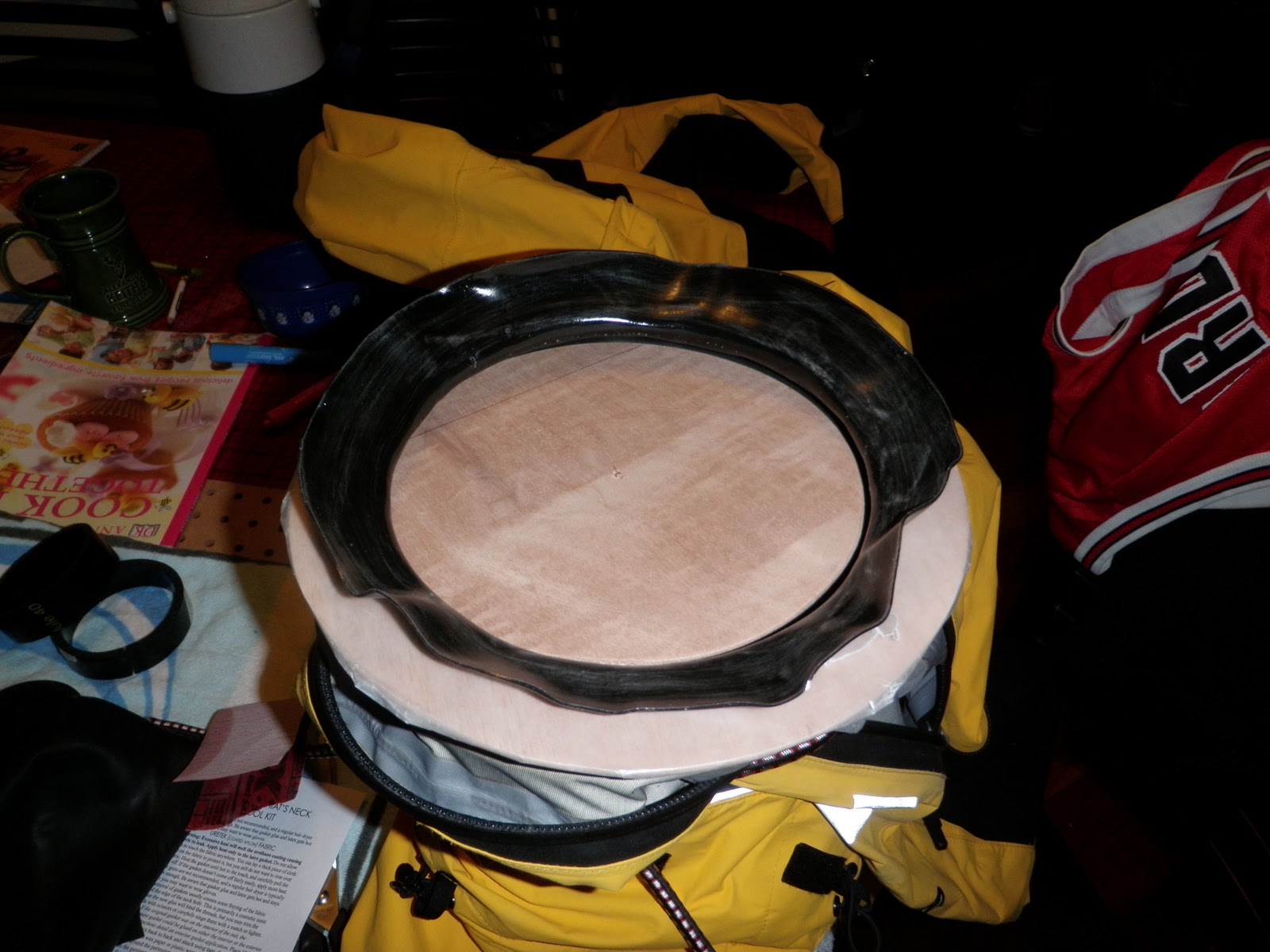
I whipped up a laminated wooden back band using some scrap 4mm ply left over from the hull.

Test fitting the laminated back band.
When it comes to foam, I always rely on the garden variety floor tile foam found at your local hardware store. 12.00 gets you an amount equivalent to a 2' x 2' x 2" piece of minicell foam!! Not a bad deal. You just need to laminate it if you need thicker stock. I use Marine Goop for this.

Foam tile with back band cut out.

I went with an angled foam pillar for a single support for the back band. I cut 6 pieces and glued them together. The lip of the seat plus friction holds the pillar in place.

Dry fitting the pillar pieces.

Clamping.

I used Marine Goop to glue the back band to the pillar. This stuff is very tenacious and with a large, flat gluing surface, this will not let go!! I added Gorilla Tape as an extra to keep the whole thing together. For those wondering, you will not see this tape as it's inside the hull and behind the seat.

From the back.

From the right side.

In place.

Initially, I had the back band snug to the rear coaming but this would severely hamper the self-bailing capabilities of the boat. One lift of the bow completely empties the hull and I did not want to mess with this at all. The whole assembly can be removed in seconds, if need be.

Showing the gap.

Of course it's too wet and cold to be doing this all outside, so the work was performed in the comfort of the living room - complete with woodstove that often made the heat unbearable. Great for drying the glue and paint, though.
Typical Friday night at my house!!

I have yet to test the new setup in the water but it's mighty comfortable sitting in it here in the living room. I also re-did my thigh and hip braces so I'm all ready to go. Sunday looks like a windy day on the water and may be just the time and place to give 'er a test!!

Sunday, October 23, 2011

Stick a fork in me, I'm done - again!!

Having built two boats in less than six months, I find myself just repeating blog entry names. Back in March I posted a blog entry with almost the same name when I was nearly finished the Point Bennett! Now, almost a month and a half after launching the Disko Bay, I am safe in saying that the boat is finally complete!!

Today, I made the decision that the deck lines were going to be finished. I've had the rope for several weeks but never got around to putting it on! It was a lovely fall day. It was sunny and warm so I dragged the boat out of the basement, popped into the back deck and set to work!! Besides the decklines, I also need to do some final touches on the back rest.

I've not decided on what type of flotation I will finally go with but for now I've got the fore and aft sections blocked with swimming noodles. Before drilling the holes for the aft deck lines, I had to take the noodles out.

How many noodles does it take the fill the aft hull?

Yep, all that foam does fit in there!

I originally had a foam pillar for a backrest but was finding that it created too much of a pressure point. I whipped up a new backrest with floor tile foam and it's working out great. I can add spacers behind it to change the angle. I made it to fit snug and added two wooden pegs to hold it in place.

Back band in place.

Peg to stop it from slipping forward.

The fwd hull is also stuffed with noodles and in order to keep them in place, I've cut and put in place a foam bulkhead . This bulkhead is not fastened but held in place merely by being pushed in tightly. Not a perfect fit but it works for testing purposes. I will replace with a better fit if the noodles actually work out.


This version of the Disko Bay, as it has a larger cockpit, does not have a true masik. As such, I've created one out of foam. It is put in place after you get in the boat and is removed before you exit. It acts a brace for your thighs for paddling and rolling. In the event of an emergency exit, it will simply pop put of place.

Foam masik
I used black rope for my decklines and maple for the links. The holes in the gunwales are sealed with black Goop. The following images show the lines and fittings and need no description.

In the meantime, I'm more than pleased with the outcome!!


Club Paddle - Aquaforte, October 22, 2011

KNL, traditionally, has its final club paddle in September but this year it never materialized - in that month anyway. Word went out from Gerard, a.k.a. G-man, that a paddle was being planned for the weekend of October 22-23. The weather proved more than favourable and crew of 11 paddlers showed up for a lovely-tell-yer-Mudder-kinda-day on the bay. Below are all the shots I took that day. Sorry, nothing spectacular but they'll do!!


Heading out!!

Hanging out!

Da b'ys!


Peter cruising along with Ferryland in the background!

At the Arch!

Neville in the "Alex" position!


Gerard in a cave, as per usual!

Great spot for a bite!!


Lots of water in the river!

If you look really close you will see Peter in the lower left of the falls


Our illustrious leader, G-Man!

Monday, October 3, 2011

Blowing a gasket . . .


Well, I had a feeling it was going to happen soon. While the suit is only 15 mos old, I could see tell tale signs that the neck gasket was getting soft. To be honest, I always thought that this particular gasket was rather thin. This was nice as it was not too restrictive yet it gave a good seal. Anyways, I was finally giving my suit a much-needed wash after the paddle on Sat when I noticed that the latex looked cracked. I stretched it a bit with my fingers and whammo, it ripped from top to bottom in one quick tear.  Not that I wanted this to happen but it's better to have it happen at home than on the water somewhere!!

I'd done gaskets before so I was not fazed by the prospect of having to replace it. Actually my first gasket was not a replacement but rather a new installation. Cheryl's suit had a neoprene collar and I installed a new latext gasket. That was a much harder job than just replacing an existing rubber gasket.


Split from stem to stern!!
A quick call to the Outfiters confirmed that they had an XL gasket in stock - thank gawd!  Last time I did a neck gasket I borrowed the wooden discs and ring from a fellow paddler. This time I decided to make my own because a) I know I'd need them again sometime in the future and b) the individual I borrowed them from last year is "in between" houses right now and I rather not bother him to find them for me.  A few pieces of scrap 4mm plywood and 30 minutes of work and I had my own set of jigs.  The instructions provided by Kokatat gave sizes that did not work with the gasket I had purchased so I had to re-work the inside diameter of the ring to accommodate the difference in size.

I'm not sure if this is "standard" but the old gasket was stitched to the suit fabric and sealed with seam tape. There was no glue/sealant on the gasket, itself. This made removal of the gasket a bit harder but I managed to get a pretty clean surface.

Wooden disk wrapped in wax paper and in position.

Getting ready to apply the Aquaseal.
Last time I did a neck gasket I had to use a wide variety of clamps and clothes pins and "what have ya" to hold the gasket in place while the Aquaseal setup. The biggest job was trying to get even pressure to prevent creep. But not this time!!! Schedule 40 clamps came to the rescue once again!!!  These simple little clamps are rapidly becoming my favourite tool - from hatches, to deck fittings, to cockpit coamings, to thigh braces, to gunwales, back to cockpit coamings and on to fabric skin.

Once I positioned the gasket in place, I simply ran a ring of Schedule 40s around the whole jig and voila - even pressure all the way 'round with no creep!! Also, I was not fighting with the extra weight of the metal clamps that have a tendency to pull the fabric downward and cause movement of the gasket.

Looks like some kind of insect!!

Modern art??

After making sure that the everything was seated propely I left the whole thing overnight. The next morning I pulled off the clamps, removed the jigs and  BADDA BOOM BADDA BING, a "factory" job

"Factory", as they say!!
The first time I tried this operation, I was covered in head to toe with Aquaseal, the gasket tried to creep off the jigs, I cursed and swore  etc etc. This time, it was almost too easy. Familiarity with the process and remaining calm are the big things - and, let's not forget that those Schedule clamps make all the difference in the world!!

Now I need to do a "real world" test  to see how it all works out, i.e., check for leaks!!  I'll also have to be bit more vigilant with the UV protectant as well!!

Thanks for dropping by,

Sean

Sunday, October 2, 2011

Absence makes the heart grow fonder . . .

There's an old saying that absence makes the heart grow fonder. In other words, if you're without something for a while, you'll find that you really like it or miss it!!  Today was the first time in some time that I took the Point Bennett (PB) out for a cruise. With the Disko Bay being the "latest thing", I've spent more time playing with it, figuring out its idiosyncrasies and trying to make it comfortable. In the meantime I've forgotten how the PB feels on the water. I've spent a fair bit of time/effort making the PB fit me and today, when I sat the cockpit, it all came back.  "Hand in a glove" is a term used to describe two things that fit well together. When I sat in my PB today, that is how I felt. I was home. I was comfortable.

PB waiting to hit the water at St. Philips

Today was an easy paddle. I sat in the back of the group and just tooled along - enjoying the lovely warm day, the bounce of the water. No need to push.  We had a headwind on the way up but nothing serious. On the trip back we had a following sea. I caught a few good waves and was quickly reminded how fast this boat can be. "Rocket" comes to mind!!  No skeg in a following sea means you have to rely on edging for control - maybe a bit of paddle rudder to keep you on track. All was good.

Today was a good day to remember that the PB is a damn fine boat to paddle - real sea boat!!

Sean


Sunday, September 25, 2011

Where it all began . . .


In the "About Me" section to the right of this post, you'll see that I mention making a skin on frame (SOF) kayak at the age of 13. For years (perhaps 30) this little boat has languished in the crawlspace under my uncle's log house. I knew it was there but never really bothered to look at it - until this weekend.

With the completion of my new SOF, the Disko Bay, I experienced a new desire to see the boat where it all began, i.e., my interest in kayaking and kayak construction. I decided to dig out the old boat and see how I made out with the build.

Before moving onto the pictures, there are a number of things you must take into consideration:

a) I was only thirteen,
b) I had never laid eyes on a real kayak other than in pictures,
c) I built this without any adult help whatsoever. My Dad worked at Horwood Lumber and provided me with the materials but everything else was done solo, 
d) I did not have a workshop. I built in the kitchen at first and later in a makeshift shelter outside and
e) I did not have a plan. I simply drew it up and went from there.

For 30 years in a damp, unheated, dirt-floored crawlspace, the boat has held up remarkably well. There is no rot in the wood and only one section of canvas has shown deterioration.

The boat measures 13' feet long by 21" wide with a foredeck height of 11". Initially the foredeck was flat with a very small opening for the legs. I found this too hard to enter so I raised the foredeck by adding a curved piece onto the existing frame. I then stitched in a new piece of canvas to accommodate the structural changes. This added piece of canvas is the only one showing significant damage.


When I raised the foredeck, I added two pieces of plywood to either side to give the cockpit a more oval shape than the initial fully open rectangle.  I added a backrest but I'm not sure why I made it pointy!?!?!? Not the best boat for doing layback rolls, what??


Cockpit looking fwd.

Showing the raised foredeck.
I'm not sure how I came to know about how to build a SOF but my construction techniques are not a whole lot different than those used on the Disko Bay.

You will notice that I screwed up on the stringer placements. Instead of placing the middle stringers at the chine, I put them in the middle. This resulted in the ribs/frames poking out the canvas. I did not notice this until I had the thing skinned and as the paint dried, it pulled the fabric taut and my mistake became painfully obvious. I always thought that is made the hull look like a starving cow!!

Looking fwd.

Port bow. Can't remember if the rocker was intentional or not.

Certainly not fancy but a good first try for a 13 yr old!!
If you are to paddle, then, obviously, you need a paddle. If you can build a boat, then you can build a paddle, I figured. My Dad gave me a piece of handrail and I fastened two plywood blades - and voila, an unfeathered kayak paddle. I re-found the paddle a couple of years ago in the woods and saved it from the elements by putting it in the shed. This weekend is the first time in 30 years that they've been reunited.

Boat and paddle - reunited and it feels so good.
I'm thinking that I'll put this boat in my basement now. It's dry and free of bugs or any other creatures who'd do it harm. It'll never hit the water again but it will hold it's place with my other boats.

As I was revisiting the past with this old boat, my Disko Bay was close by getting a new coat of paint. While these two boats are world's apart in finesse and craftsmanship, they are basically the same concept. It's just that one was built by a 13 year old boy with no knowledge of kayak design and/or construction. The other was built by a 45 year old man with a wealth of information found on the Internet and in books, with all the necessary tools and a workspace and with firsthand knowledge on how to actually paddle a kayak. All things considered, that 13 year old boy did alright, don't you think?

SOF - the latest iteration.

Hmm, this one doesn't look like a starved cow.

Thanks for dropping by and reliving a little history with me.

Sean